Understanding bank reconciliation statements: A step-by-step guide
Managing your finances effectively is like putting together a complex puzzle. One crucial puzzle piece is reconciling your bank statements. It involves comparing your records with the transactions reported by the bank to ensure they match. Bank reconciliation statements are vital in detailed visibility into cash availability, achieving accurate reporting, and getting a faster financial close.
In this blog, we will look at the significance of bank reconciliation statements and provide a step-by-step walkthrough on preparing them. We'll also share valuable tips to simplify the process and streamline your financial management. By the end of this blog, you'll have the confidence to tackle your bank reconciliation statements like a pro.
Key takeaways
Bank reconciliation statements are financial health checks that compare your records with the bank's statements.
Regular bank reconciliations can help detect errors, track charges, confirm receipts, and more.
The goal of bank reconciliation is to ensure balance consistency between your cash book and bank statement.
Modern bank reconciliation software can automate and streamline the process.
Seek help from financial experts if needed to ensure accuracy in your accounts and for understanding bank reconciliations.
Bank reconciliation statement meaning
A bank reconciliation, or "bank rec," is like a financial health check. It's when you compare your record of money coming in and out (from your accounting system) to what your bank or credit card statement says. When you run a business or manage money, you keep track of every payment and expense (like paying rent) and note down what it is for. This is called bookkeeping.
Each month, you should do a bank reconciliation. You check that everything you've recorded matches what your bank or credit card statement says. If it matches, something needs to be fixed. You may have missed something, or there's an error somewhere, so you need to find out what happened and correct it.
Doing a "bank rec" helps you trust the money information in your accounting system and understand any differences between it and your actual bank or credit card balances. If you can't figure it out, you might need to get help from an expert.
Bank reconciliation statement definition
A bank reconciliation statement can be defined in simple words as a type of report that a business uses to make sure its money records match the bank's record. This report includes all the money the company has added or removed from their bank account over a certain period. This helps to identify any errors or suspicious activities.
Problems with bank reconciliation statement
Bank reconciliations can have a few problems that come up frequently. Here are the main ones you should know about:
-
Cheque that hasn't been cashed:
Sometimes, there are checks that you've written, but the recipients haven't cashed them yet. These checks can stay on your list of uncleared cheques in your accounting software. You should track them and find out if the recipients received the cheque. If they haven't, you'll need to cancel the old cheque and issue a new one.
-
Voided cheque that still get cashed:
Sometimes, if a cheque remains unclear for a long time, you might void it and give a new cheque to the payee. But what if the payee cashes the original check anyway? If you told the bank to void the cheque, they should reject it when it's presented. If you didn't void it with the bank, you need to record the cheque as if it was cashed and make the necessary adjustments in your accounts.
-
Returned deposited cheques:
Sometimes, the bank may not accept a cheque you tried to deposit, especially if it's drawn from a foreign bank account. In this situation, you need to reverse the initial entry for that deposit and make the necessary adjustments in your reports.
Reasons for preparing a bank reconciliation statement
Let's delve into the unique reasons why preparing a bank reconciliation statement is an absolute must:
-
Identifying accounting errors:
Bank reconciliation is vital in detecting accounting errors, such as missed or double payments. These errors can have significant consequences, leading to embarrassing situations or damaging relationships with customers and suppliers. By conducting regular bank reconciliations, businesses can quickly spot and address such mistakes promptly, ensuring accurate financial records.
-
Managing risk:
Bank reconciliations serve as a risk management tool by helping to identify fraudulent transactions. Detecting discrepancies between the company's records and the bank statement can alert businesses to potentially unauthorized transactions, reducing the risk of financial losses and penalties. Promptly addressing such issues can safeguard the company's economic well-being.
-
Tracking interest and fees:
Regular bank reconciliations enable businesses to track interest payments, fees, and penalties imposed by the bank. By comparing the bank statement with their records, companies can accurately record these amounts in their books, ensuring the financial statements reflect the actual financial position.
-
Confirming receivables:
Bank reconciliations help in confirming all the receipts recorded by the company. This process prevents the embarrassment of chasing payments that have already been received and ensures that any entries for receipts yet to be deposited are identified and addressed promptly.
-
Cash control:
Performing bank reconciliations contributes to improving internal control over a company's cash. Ideally, the reconciliation should be conducted by someone independent of the person handling and recording receipts and payments. This segregation of duties reduces the risk of unauthorized use of the company's cash, enhancing financial security.
-
Enhancing accuracy and confidence in the balance sheet:
Accurate financial reporting is essential for businesses and stakeholders. Bank reconciliations help ensure that the cash balance reported on the company's balance sheet is precise. By comparing the bank statement with the general ledger, any discrepancies, such as outstanding payments or deposits in transit, can be identified and noted as timing differences. This reconciliation process reduces the likelihood of errors in the company's financial records and ensures the overall accuracy of the balance sheet.
-
Utilizing modern accounting software:
Modern cloud-based accounting software offers automation and efficiency advantages. It allows businesses to reconcile bank accounts periodically, accounts for charges and unanticipated transactions, and saves time by utilizing live bank feeds. Furthermore, the software streamlines the reconciliation process, enabling businesses to close each month faster with increased confidence in the accuracy of their financial records.
Steps in preparation of bank reconciliation statement
-
Step 1: Handling outstanding balances:
Review the initial balances in your cash book's bank column and statement. Any differences may be due to uncleared items like checks from the previous month that still need to be presented or credited. For example, your bank statement shows a balance of $5000, but your cash book shows $4800; the $200 difference could be due to a check issued last month but still needs to be cleared.
-
Step 2: Cross-verifying debit and credit entries:
Next, compare the entries on the credit and debit sides of your bank statement and cash book. For instance, if a deposit of $1000 is entered as a credit in the bank statement, it should appear as a debit in your cash book, and vice versa.
-
Step 3: Identifying unrecorded entries:
Review your checkbook and the bank column of your cash book for any transactions that may have yet to be noticed. For instance, if a check for $100 was written but not recorded in the cash book, it should be added.
-
Step 4: Rectifying errors:
Correct any mistakes found in the cash book. For example, if an outgoing payment of $200 was mistakenly recorded as $20, correct the entry to reflect the correct amount.
-
Step 5: Recalculating entries:
Calculate the new balance in your cash book's bank column after making any necessary corrections. If you started with $4800, corrected an $180 error, and added a missed $100 entry, your updated balance would be $4920.
-
Step 6: Drafting the bank reconciliation statement:
Prepare your Bank Reconciliation Statement based on these updated records. Your statement should start with the updated cash book balance ($4920 in this example) and then account for any outstanding items.
-
Step 7: Incorporating unrepresented checks and deducting un-credited checks:
Unpresented cheques, or those yet to be delivered to the recipient, should be added to the bank statements balance. Conversely, un-credited bills, those yet to be collected by the recipient, should be deducted. For instance, if you have a $100 check, you wrote but forgot to deliver, this should be added to your bank balance.
-
Step 8: Applying final adjustments:
Make any final adjustments and review for any remaining errors. Mistakes can occur more frequently during busy times, but this process helps eliminate them. For example, if the bank charged a $25 fee not recorded in your cash book, this should be deducted from your cash book balance.
-
Step 9: Ensuring balance consistency:
The final balances of the bank statement and the cash book should align once all corrections, additions, and deductions are made. If you started with a bank balance of $5000, added a $100 un-presented check, and subtracted a $25 fee, your final bank balance would also be $4920, matching the cash book balance.
Bank reconciliation example
Let's consider the following data to understand the bank reconciliation statement in a better way:
| Balance as per passbook | Amount (In $) | Amount (In $) |
|---|---|---|
| Bank Statement Balance | $10,000 | - |
| Add: Deposits in Transit | $600 | - |
| Less: Outstanding Checks | - | $500 |
| Corrected Bank Statement Balance | $10,100 | - |
| Cash Book Balance | $9,000 | - |
| Add: Interest Earned | $100 | - |
| Less: Bank Service Charges | - | $50 |
| Add: Errors (overstatement) | $50 | - |
| Corrected Cash Book Balance | $9,100 | - |
| Difference (should be 0 if reconciled) | - | $0 |
Explanation:
- The Bank Statement Balance is the balance as per the bank's records.
- Deposits in transit are deposits that have been recorded in the company's Cash Book but still need to be recorded by the bank. We add them to the Bank Balance.
- The company has issued outstanding cheques but still needs to clear the bank. We subtract them from the Bank Balance.
- After adjustments, we get the Corrected Bank Balance.
Next, we adjust the cash book balance:
- The Cash Book Balance is the balance as per the company's records.
- Interest earned is the interest received from the bank but has yet to be recorded in the Cash Book. We add it to the Cash Book Balance.
- Bank Service Charges are charges imposed by the bank but have yet to be recorded in the Cash Book. We subtract them from the Cash Book Balance.
- Errors are discrepancies due to errors in recording transactions. In this case, a check was wrongly written as $400 instead of $350, so we have overstated our balance by $50. We add this to the Cash Book Balance to correct the error.
Finally, we reconcile the two balances. If the Corrected Bank Statement Balance and the Corrected Cash Book Balance match, the reconciliation is successful and the difference is zero.
Tips to streamline bank reconciliation
Here are the top 10 tips to help you streamline the process of bank reconciliation:
-
Establish a routine:
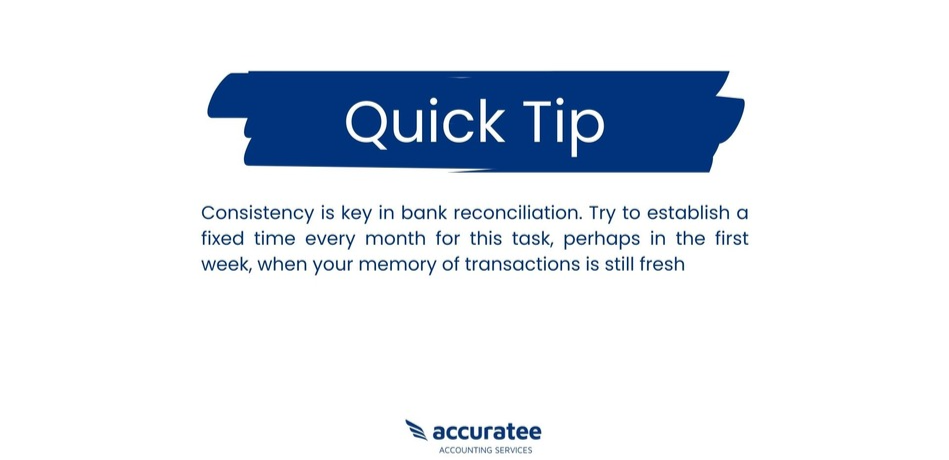
Set aside regular time to review your accounts every month. This will help you identify any discrepancies quickly and make it easier to reconcile the statements in a timely fashion.
-
Use accounting software:
Accounting software like Xero or Quickbooks can streamline the reconciliation process by organizing transactions, flagging discrepancies, and providing reports that make it easy to compare data.
-
Regularly reconcile bank statements and account registers:
Comparing the two documents regularly can help you quickly identify errors and make reconciling your accounts easier.
-
Automate transactions whenever possible:
This will reduce the number of manual entries you have to enter, which can lead to fewer discrepancies and errors in the reconciliation process.
-
Review all transactions and check for any discrepancies:
It is essential to thoroughly review each transaction, as this helps you identify any errors or discrepancies that could affect the reconciliation process.
-
Monitor bank accounts regularly:
Keeping a close eye on your bank accounts makes it easier to spot any unusual activity and investigate it immediately. This will help you to find potential discrepancies and make the reconciliation process faster and more efficient.
-
Investigate any discrepancies immediately:
If you notice any unusual activity or discrepancies, it is important to investigate them as soon as possible to prevent any further errors from occurring.
-
Keep accurate records:
It is important to keep accurate records of all transactions and bank statements so that you can easily refer back to them when needed. This will also help you identify any discrepancies quickly.
-
Have a backup plan in place:
Having a backup plan in case something goes wrong during the reconciliation process is always a good idea, as this will help you avoid costly mistakes and delays.
-
Stay organized:
Staying organized and creating systems for filing and organizing financial documents will make it easier to complete the reconciliation process promptly. This will also help you identify any discrepancies quickly and easily.
Conclusion
Understanding bank reconciliation statements is easier than it may seem. Using a systematic approach to reconciling accounts, you can ensure that discrepancies are caught early, and steps have been taken to identify and rectify any mistakes. With the tips outlined in this article and some practice, generating accurate bank reconciliations can be straightforward.
Taking the time to understand your business's cash flows is an essential part of managing finances properly. If you need more help with understanding bank reconciliations or need assistance with activities such as bookkeeping, don't hesitate to contact the team of experts at Accurate. Our experts are always available to help you make sure your accounts are accurate and up-to-date. Contact us today to learn more about how we can help you streamline the bank reconciliation process.