What is the concept of accounts payable, and what are the top strategies for effective accounts payable management?
Accounts payable is a fundamental component of financial management within businesses. It encompasses the money owed by a company to its vendors, suppliers, and creditors for goods and services rendered. This blog delves into the concept of accounts payable, providing a comprehensive understanding of its significance in organizational operations. Additionally, we explore the top strategies employed for effective accounts payable management, aiding businesses in streamlining processes and enhancing overall efficiency. By implementing these strategies, companies can establish financial stability and ensure seamless operations in their day-to-day activities.
Key takeaways
Accounts payable refers to the money a business owes for purchases made on credit, and it is classified as a liability account in double-entry accounting.
Effective accounts payable management is crucial for businesses to maintain financial stability, avoid disruptions, and build strong supplier relationships.
Clear communication with suppliers is essential for an effective accounts payable process.
Transitioning from paper to digital invoices significantly improves efficiency and aligns with modern sustainability practices.
What are accounts payable?
Accounts payable refers to the money your business owes for purchases made on credit. Whenever you acquire goods or services, the cost of these items or services increases your accounts payable balance.
These goods or services are all acquired on credit, meaning the payment is due within a specified period. Failure to settle the payment within this agreed period may result in a late fee or a penalty.
In double-entry accounting, accounts payable is classified as a liability account, whereas accounts receivable is classified as an asset. Thus, any increase in accounts payable will be offset by a corresponding decrease in cash or an increase in accounts receivable.
How do the accounts payable process work?
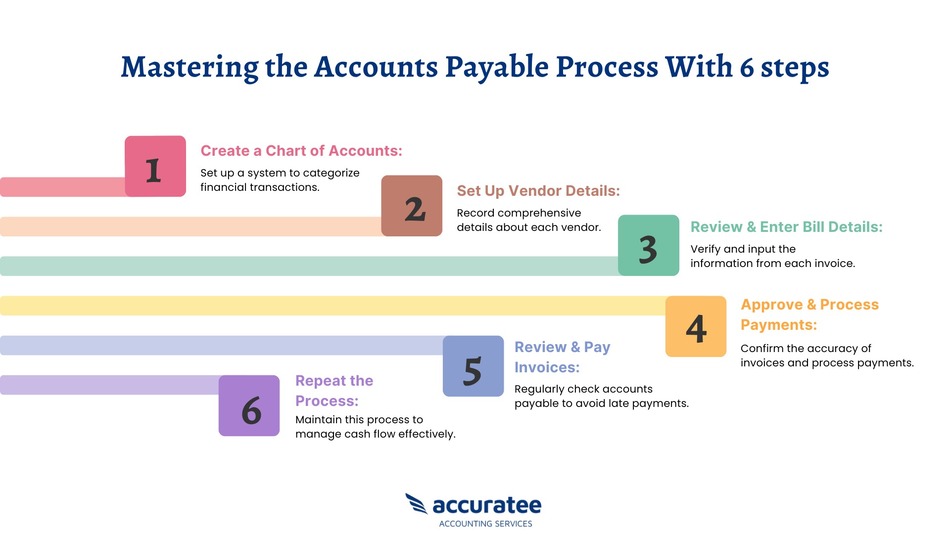
The accounts payable process is a set of steps businesses follow to manage and pay their outstanding invoices to vendors and suppliers. Here is a detailed explanation of how the AP process works:
-
Step 1: Create a chart of accounts:
Businesses need to establish a chart of accounts before starting the accounts payable process. This chart categorizes and organizes all financial transactions, including accounts payable. It helps in accurately recording expenses and tracking payables.
-
Step 2: Set up vendor details:
Businesses must set up vendor details in their cloud-based accounting system. This includes recording information about each vendor, such as name, contact details, payment terms, and any specific agreements. Payment terms specify when the payment is due, such as Net 30 or 2/10 Net 30. Net 30 means that the payment is due within 30 days from the invoice date. 2/10 Net 30 means that if the payment is made within ten days, a 2% discount can be taken. Otherwise, the full payment is due within 30 days.
-
Step 3: Review and enter bill details:
An invoice from a vendor should be thoroughly reviewed for accuracy. If the invoice is for products received, verify that the items listed match what was received. For service invoices, ensure that the services were provided as described. Once reviewed, the bill details are entered into the accounting system or ledger accounts, associating them with the appropriate vendor and expense account.
-
Step 4: Approve and pay bills:
Once the bill information is entered, it needs to be approved before making the payment. This is done by the business owner or someone responsible for managing finances. They check that everything is correct and authorized for payment. Once approved, the payment details, such as invoice number, due date, and amount, are recorded, and the bill is paid according to the agreed-upon method of payment.
-
Step 5: Review and pay invoices:
Regularly reviewing accounts payable is crucial to ensure on-time payments. Typically, businesses review their payables weekly to determine which invoices are due for payment. Various payment methods, such as writing a cheque, processing checks through accounting software, using a company credit card, or electronic payment methods like Eftops or Secure Pay, can be used. The chosen payment method should be communicated to the vendor, and if paying by cheque, it's common to include a copy of the invoice with the payment.
-
Step 6: Repeat the process:
The accounts payable process is an ongoing cycle that needs to be repeated regularly. By following a weekly cycle, businesses can avoid late payments, maintain good vendor relationships, and manage their cash flow effectively. This involves consistently reviewing and processing invoices, approving payments, and staying organized with documentation.
Most common accounts payable issues
Businesses need help with several challenges and issues regarding their accounts payable processes. Let's break them down in simple terms:
-
Inaccurate or missing data:
One of the most common problems in accounts payable is dealing with inaccurate or missing data. This can happen when suppliers provide incorrect invoices, missing information, or data entry errors occur during invoice processing. Inaccurate data can lead to payment delays, disputes, and reconciliation issues, causing frustration for the accounts payable department and suppliers.
-
Manual and paper-based processes:
Many businesses still rely on manual and paper-based processes for their accounts payable operations. This can be a significant challenge as manual processes are time-consuming, error-prone, and need more transparency. Paper-based invoices and documents can easily get lost or misplaced, making tracking and processing payments difficult. Manual processes also require extensive manual data entry, which increases the risk of errors and delays.
-
Poor communication and collaboration:
Lack of effective communication and collaboration between the accounts payable department and other stakeholders, such as procurement or receiving departments, can lead to problems in the accounts payable process. For example, if there is a discrepancy between the goods received and the invoice, it may take time to resolve the issue due to poor communication channels. Delayed communication can result in late payments, strained supplier relationships, and increased risk of disputes.
-
Inefficient approval workflows:
In many organizations, accounts payable invoices require multiple levels of approval before payment can be made. However, inefficient approval workflows can lead to bottlenecks and delays in processing invoices. If there is a lack of clarity regarding approval authority or if approvers are not responsive or available, it can significantly impact the early payment of invoices.
-
Fraud and security risks:
Accounts payable processes are susceptible to fraud and security risks. For example, employees or external parties can create fraudulent invoices or payments, leading to financial losses for the organization. Inadequate controls and lack of segregation of duties can make it easier for fraudulent activities to go unnoticed. Furthermore, if sensitive financial data is not adequately protected, there is a risk of data breaches and unauthorized access to confidential information.
For efficient payment processes, businesses must manage accounts payable effectively to avoid disruptions and maintain financial stability.
What are accounts payable management?
Accounts payable management involves overseeing and controlling a company's outstanding financial obligations to its vendors, suppliers, and creditors. It involves managing the company's payables effectively to ensure timely payments while optimizing cash flow and maintaining good supplier relationships.
Why is accounts payable management essential?
Accounts Payable (AP) is a system that a business uses to pay for the stuff it buys, except for wages. It's like the business's checkbook, keeping track of all the money spent, which is very important for when it's time to do taxes or check on how money was spent.
-
Here's what AP aims to do:
- Make sure the payments are correct and fair.
- Try to get discounts by paying early or adjusting payments.
-
Managing AP is essential for a business to run smoothly:
- It ensures bills are paid on time, which is good for the company's reputation and keeps suppliers happy.
- Paying bills on time also avoids extra costs like late fees.
- It helps control how much the company spends and prevents duplicate payments, ensuring it only pays once for the same thing.
- It keeps a record of what the company buys, so everything runs smoothly and smoothly in the work of the business.
- It collects all the accounts payable expense details in one place for easy finding.
- It reduces the chances of getting tricked with fake purchases by carefully checking each buying step.
- It also helps better management of cash flows by making sure payments are made only when they're due and taking advantage of early payment discounts or any credit (like a short-term loan) that suppliers offer.
Top 10 strategies for effective accounts payable management
Here are the top 10 strategies that help you to improve accounts payable management if implemented strictly:
-
Tip 1: Communication is a key:
Open and clear communication with your suppliers is the backbone of an effective accounts payable (A/P) process. It's important to establish the lines of communication early on, outlining your payment terms and schedules. This approach can help avoid confusion, ensure timely payments, and maintain a positive business relationship. If there are any changes in payment schedules or potential delays, informing suppliers ahead of time shows respect and fosters trust. A supplier portal could also be beneficial, providing suppliers with real-time updates on payment status and reducing the need for constant back-and-forth communication.
-
Tip 2: Get rid of paper:
Transitioning from paper to digital invoices can vastly improve the efficiency of your A/P process. Digital invoices arrive faster, can be easily organized, and are less prone to loss or damage. Using digital invoices can also free up physical space previously used for storage, reduce overhead costs, and improve the efficiency of the search process. Moreover, adopting digital invoices aligns with modern sustainability practices, minimizing the carbon footprint of your business.
-
Tip 3: Plan your priorities:
With the multitude of tasks in A/P, setting priorities can ensure nothing falls through the cracks. Centralized controls and reporting systems can give a holistic view of the A/P operations, making it easier to determine what needs immediate attention. Prioritization can also help in optimizing cash flow, identifying cost-saving opportunities, and enhancing relationships with suppliers. This strategy fosters an organized and efficient A/P process, ensuring that critical tasks are attended to, and potential issues are addressed promptly.
-
Tip 4: Know what you're aiming for:
Defining clear benchmarks can provide a roadmap for your A/P department to strive towards. By monitoring these benchmarks, you can identify areas of improvement and ensure that performance is consistently high. This could include evaluating the productivity of the A/P staff, reviewing the speed of payment authorizations, or assessing supplier performance. Establishing benchmarks allows for proactive management, helps reduce discrepancies, and drives the overall performance of the A/P process.
-
Tip 5: Keep things simple:
Simplifying your A/P process can lead to increased efficiency and accuracy. You can expedite the processing time by empowering the A/P team to make non-critical decisions. Consolidating payment runs and automating invoice processing can further streamline the process. A simplified, straightforward A/P process reduces the likelihood of errors, improves operational efficiency, and allows your team to focus on more strategic tasks.
-
Tip 6: Get things right:
Accuracy is essential in A/P management. Meticulous invoice checking, verifying received goods or services, and diligent data processing can prevent costly mistakes. By emphasizing accuracy, you can avoid payment errors and disputes with suppliers. This approach reinforces the trust of suppliers and ensures that the financial data your company relies on is correct.
-
Tip 7: Watch out for fraud:
Fraud poses a significant risk to the A/P process. Implementing stringent access controls, regularly auditing transactions, and training your team to recognize common fraud attempts can safeguard your operations. A vigilant approach to fraud prevention protects your financial resources, maintains your company's reputation, and ensures a secure A/P process.
-
Tip 8: Put everything in one place:
Centralizing A/P operations can significantly enhance efficiency and visibility. A centralized system provides a unified platform where all data and operations can be managed, ensuring standardization of procedures and easier tracking. Going paperless and digitizing your A/P processes can further consolidate your operations, providing additional benefits such as easy retrieval and increased security.
-
Tip 9: Implement an early payment discount:
Implement an early payment discount program to encourage suppliers to get paid sooner. By offering discounts for prompt payment, you can improve cash flow, negotiate better terms, and save costs. Analyze the impact of discounts on your cash flow and find the right discount rate that benefits both your business and suppliers.
-
Tip 1O: : Invest in cybersecurity:
Cybersecurity is essential for safeguarding the company's sensitive data. As your A/P process becomes increasingly automated, ensuring your systems are secure from malicious actors should be prioritized. In addition to having updated antivirus software, it's essential to use strong passwords and two-factor authentication whenever possible.
Conclusion
Accounting for accounts payable is an essential part of any business. To ensure that the process runs effectively and efficiently, staying on top of strategies such as staying organized, being proactive, fostering relationships with vendors, and embracing automation is essential. By utilizing these measures, businesses can save time and money while improving their accounts payable process at the same time.
Being disciplined with accounting procedures also encourages better governance while protecting the company from potential fraud or error. Consider implementing these suggestions into your accounts payable management today and enjoy a smoother workflow.
If you're ready to take your organization's accounts payable strategy to the next level, Accurate can help. We have decades of experience providing world-class accounting payables services to businesses worldwide. Contact us today for a free initial consultation and get on your way to optimized accounts payable management!