How to lodge BAS correctly: Avoiding common mistakes
Business Activity Statements (BAS) are a key requirement for any business registered for GST in Australia. They are used to report goods and services tax (GST), pay as you go (PAYG) withholding, PAYG installments, and a range of other tax obligations directly to the Australian Taxation Office (ATO).
For new business owners, preparing and lodging a BAS for the first time can feel overwhelming. The process involves strict deadlines, detailed reporting rules, and the reconciliation of multiple figures.
Even small mistakes can create big problems, such as penalties, delays in GST refunds, or unwanted attention from the ATO. In this blog, we look at the most common BAS lodgement mistakes that trip up businesses and explain how our tax experts help you prevent them.
Key takeaways
A BAS is required for all GST-registered businesses to report GST, PAYG, and other tax obligations.
Entering GST-inclusive instead of exclusive figures is a common cause of BAS errors.
GST credits cannot be claimed on GST-free or personal expenses.
All income, including cash and overseas sales, must be reported in your BAS.
Missing BAS deadlines leads to costly penalties and delayed GST refunds.
Outdated accounting software settings increase the risk of repeated BAS mistakes.
What is a business activity statement (BAS)?
A Business Activity Statement (BAS) is a form that businesses registered for GST in Australia must lodge with the ATO to report and pay various tax obligations. Through your BAS, you report.
- Goods and Services Tax (GST) collected and paid
- Pay As You Go (PAYG) instalments
- PAYG withholding tax from employee wages
- Other taxes such as fringe benefits tax (FBT) instalments, luxury car tax (LCT), wine equalisation tax (WET), and fuel tax credits
Feeling overwhelmed with BAS?
Common BAS lodgment mistakes that could cost thousands of dollars to your business
Below are the most common BAS lodgment mistakes that business owners in Australia make when preparing and lodging their activity statements, along with tips to avoid them.
Mistake 1: Mixing Up GST-inclusive and GST-exclusive figures
One of the most frequent BAS errors occurs when GST-inclusive amounts are entered where exclusive figures are required, or the other way around. This results in incorrect totals being reported to the ATO and may cause overpayment or underpayment.
Tips to avoid it:
- Check your accounting software settings before you generate BAS reports.
- Run both GST-inclusive and GST-exclusive reports in Xero or MYOB to confirm figures align.
- Keep a simple checklist of which BAS labels require exclusive amounts to avoid confusion at lodgement time.
Mistake 2: Claiming GST on ineligible expenses
One of the most common BAS errors happens when businesses claim GST credits on expenses that don’t qualify. This occurs in two ways:
- Business costs that are GST-free: Items such as bank charges, ASIC fees, PayPal transaction fees, some insurance, and health or education services do not include GST, so credits should not be claimed.
- Personal or private purchases: Non-business expenses such as personal loans, director’s fees, or private household costs must never be included in a BAS.
- Tips to avoid it: Review the GST code for each transaction before lodging BAS online. Keep a checklist of GST-free categories and maintain a clear separation between business and personal spending with professional bookkeeping support.
Mistake 3: Forgetting to report all business income
Cash payments, overseas sales, and barter transactions must all be reported in BAS lodgements. Many businesses overlook these, but the ATO cross-checks BAS information against bank accounts and third-party payment systems. Missing income raises red flags and can lead to compliance reviews.
Tips to avoid it:
- Reconcile your accounts monthly instead of waiting until the end of the quarter.
- Review sales records from all channels, including cash, EFTPOS, PayPal, and overseas accounts.
- Use accounting software that integrates with your payment systems to reduce the chance of missed income.
Mistake 4 : Mistake errors in PAYG withholding
PAYG withholding is a common area for mistakes, especially when payroll data is not reconciled properly. Employers sometimes understate or overstate the amounts withheld from employee wages, and errors with superannuation reporting often flow into the BAS.
Tips to avoid it:
- Always reconcile payroll figures before preparing BAS.
- Use Single Touch Payroll (STP) reporting or let our payroll team ensure accuracy between payroll and BAS.
- Double-check superannuation contributions and PAYG figures against payslips before submitting.
Mistake 5: Late lodgement and payment
Missing BAS deadlines is one of the costliest mistakes. Penalties increase the longer the BAS remains outstanding, interest charges accrue daily, and GST refunds are often delayed until past lodgements are resolved.
Tips to avoid it:
- Set recurring digital reminders in your calendar for BAS due dates.
- Keep your bookkeeping up to date throughout the quarter, so reports are ready early.
- Lodge BAS through a registered BAS agent like CleanSlate, who may secure extra time to lodge and provide professional oversight.
Mistake 6: Ignoring adjustments or carry-forward credits
BAS adjustments are often overlooked, particularly for bad debts, cancelled invoices, or goods returned after a sale. Ignoring these adjustments inflates liabilities and reduces cash flow unnecessarily.
Tips to avoid it:
- Review customer accounts for credit notes or bad debt write-offs each quarter.
- Ensure supplier credits or adjustments are entered into your accounting system before generating BAS.
- Keep a separate adjustment log so nothing is missed during lodgement.
Mistake 7: Relying on outdated or incorrect accounting software settings
Accounting software simplifies BAS lodgement, but if the setup is wrong, the errors repeat across multiple periods. Outdated GST codes or incorrect tax categories cause transactions to be misclassified, resulting in inaccurate figures being lodged with the ATO.
Tips to avoid it:
- Regularly update software settings in Xero, MYOB, or QuickBooks.
- Check that GST codes are applied correctly to each type of transaction.
- Run test BAS reports mid-quarter to catch problems before lodgement
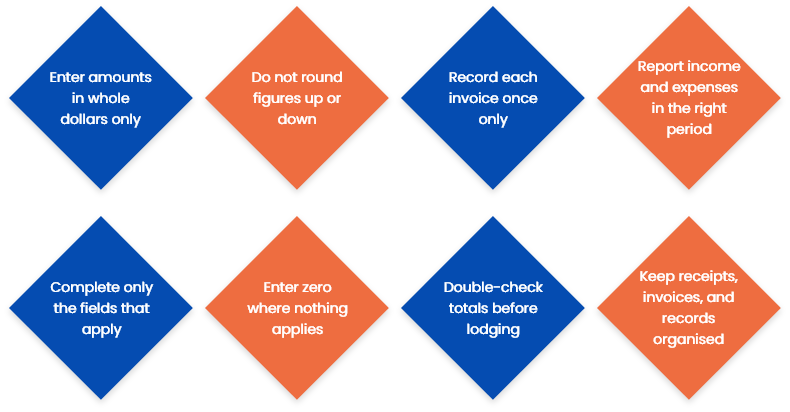
Checklist for BAS completion
Follow these BAS preparation tips to complete your BAS return accurately and on time.
How to fix BAS errors?
Fixing BAS errors quickly is essential to avoid penalties, interest charges, and delayed GST refunds. The ATO allows corrections through different methods depending on the size and type of the issue.
Correcting BAS errors in the next BAS
Smaller issues, such as GST or fuel tax credit discrepancies, are often corrected in the next reporting cycle. This option is available only if the error is within the ATO’s correction limits.
Revising a previously lodged BAS
For larger errors or those involving PAYG withholding, a revision of the original BAS is required. You can revise BAS online through ATO Online Services for Business, submit via SBR-enabled software such as Xero or MYOB, or engage a registered BAS agent for professional support.
How to make BAS adjustments?
BAS adjustments are different from errors because the original lodgement was correct at the time, but later events changed the outcome. Examples include cancelled sales, goods returned, or updated tax invoices from suppliers.
Instead of revising a past BAS, adjustments are usually reported in the current BAS lodgement period. This keeps your reporting aligned with ATO requirements without re-opening older statements.
FAQs
Who needs to lodge a BAS?
Any business registered for GST in Australia is required to lodge a Business Activity Statement (BAS). This obligation starts once your annual turnover exceeds $75,000, or $150,000 for not-for-profits.
How often do I need to lodge BAS?
The frequency of BAS lodgement depends on your turnover and ATO requirements. Businesses with a GST turnover of $20 million or more must lodge monthly, while most small and medium businesses lodge quarterly. Some entities with very low turnover may lodge annually. Each frequency has strict deadlines that must be followed to stay compliant.
What are the BAS due dates?
BAS due dates vary depending on your reporting cycle. Quarterly BAS are due on 28 October, 28 February, 28 April, and 28 July. Monthly BAS is due on the 21st of the following month, while annual BAS (for voluntary GST registrants) is generally due 31 October or 28 February if no tax return is required.
What is a ‘nil BAS’?
A nil BAS is required when there is no GST, PAYG, or other tax activity to report for the period. The ATO still expects lodgement even if the figures are all zero. Submitting a nil BAS confirms your obligations are up to date and helps avoid compliance concerns. It may be lodged through ATO online services, over the phone, or by mail, depending on what suits your business.
How do I lodge BAS online?
Lodging BAS online is the fastest and most secure method. You can use ATO Online Services for Business, myGov (for sole traders), or SBR-enabled software such as Xero, MYOB, or QuickBooks.
Do I need receipts to lodge BAS?
Yes, you need valid invoices, receipts, and supporting documents to substantiate your BAS. The ATO requires records to be kept for at least five years. Proper documentation is essential to claim GST credits and prove accuracy if your BAS is reviewed.
Why should I use CleanSlate for BAS?
Because BAS is more than paperwork, it’s about keeping your business compliant and cash flow protected. We take care of BAS preparation, review, adjustments, and lodgement so you don’t have to stress over deadlines or ATO rules. With us managing your BAS, you reduce errors, avoid penalties, and gain peace of mind knowing everything has been handled properly.
Avoid BAS errors with CleanSlate
Need professional support in preparing and lodging your BAS return? Our team is here to help. When you work with CleanSlate, you gain access to BAS professionals who manage the process from start to finish, so you don’t have to worry about deadlines or costly mistakes.
Here’s how we support your business with BAS lodgement:
- Collect and review records, including sales invoices, purchase bills, bank statements, and payroll reports, to ensure all GST and PAYG data is correct.
- Reconcile transactions so every entry in your accounting software matches supporting records, and no income, expense, or adjustment is missed
- Prepare and submit BAS accurately and securely through the BAS Agent Portal or approved accounting software.
- Provide reminders of due dates and payment amounts, and assist with setting up ATO payment plans if required.
- Handle any ATO correspondence or issues that may arise after lodgement.
- Offer ongoing compliance support to keep your records accurate and ready for the next BAS cycle.
With CleanSlate, you also benefit from the additional lodgement time available to registered BAS agents, giving you flexibility and peace of mind. Instead of stressing about figures and deadlines, you can rely on our team to take care of every detail while you focus on running your business. Book a call with us today and see how our BAS lodgment services give you peace of mind.